Human-first AI adoption
How Crowdcube is Accelerating Marketing Efficiency with AI Capability Building
Services
AI Enablement
Client
Crowdcube

About Crowdcube
Crowdcube is Europe's leading investment crowdfunding platform, connecting high-growth startups with retail and institutional investors. Operating as a regulated marketplace under the FCA in the UK and CNMB in Spain, the company has powered investment rounds for household names including Monzo, Revolut and BrewDog. With a lean marketing team supporting both supply-side (startups raising capital) and demand-side (investors) communications across multiple markets, operational efficiency is critical to maintaining competitive advantage in the fast-moving fintech sector.
The Strategic Challenge
As Head of Marketing, Nicola Vidal faced a challenge common to many B2B technology companies: the team had access to enterprise AI tools, but return on investment was not matching the potential. Crowdcube had rolled out Gemini Pro across the organisation, but adoption patterns were inconsistent and the team recognised they were not extracting full value from their AI stack.
"We had made the strategic decision to standardise on Gemini as our enterprise AI platform," Vidal explains. "The technology was there, the licenses were in place, but we identified a capability gap. Our team needed structured methodology to translate AI features into repeatable workflows that would deliver measurable efficiency gains."
The competitive landscape made this urgent. With well-resourced competitors producing high volumes of content and Crowdcube operating with a deliberately lean team structure, the ability to deliver high-quality output at speed was becoming a strategic imperative.
"When you look at the market, everyone is moving extremely fast," says Vidal. "We needed to deliver professional-grade content at competitive volume, but we were not going to solve that through headcount. The solution had to come through smarter deployment of the technology we already had."
The team conducted an internal assessment and identified that while individual capability varied, the organisation lacked a consistent framework for AI deployment. Most critically, there was no systematic approach to identifying which workflows would benefit most from automation, or how to structure those automations effectively.
Evaluating the Options
Vidal researched available training and capability-building options in the market. The majority focused on generic AI literacy, teaching basic prompting techniques through group sessions covering multiple industries and use cases.
"I evaluated several providers running standardised training programmes," Vidal notes. "The content was competent, but fundamentally generic. For a regulated fintech environment with specific compliance requirements, tight integration with our martech stack, and highly specialised workflows around investor communications and campaign orchestration, that approach would not deliver the precision we needed."
The AI-Native Transformation Program offered a different model: bespoke workflow mapping upfront, hands-on solution building during the session, and direct application to Crowdcube's actual processes rather than hypothetical examples.
"The value proposition was clear," says Vidal. "We would not leave with theoretical knowledge to implement later. We would build production-ready solutions during the workshop itself, using our real campaign briefs, our compliance framework, our actual data. For a lean team where every hour counts, that efficiency was compelling."
The workshop required full-day commitment from five team members, but Vidal secured stakeholder buy-in based on the expected return. "The calculation was straightforward. If we could generate meaningful time savings on even three or four high-frequency workflows, the investment would pay back within weeks."

Building Capability Through Practical Application
The workshop began with strategic context: analysis of how AI is reshaping functional capabilities across demand generation, content production, CRM operations and product marketing specifically within B2B technology environments. The team then moved into structured workflow analysis.
Working from a pre-prepared audit that mapped Crowdcube's existing processes, the team identified automation opportunities across email sequence generation, campaign brief creation, visual asset production, lead generation workflows and performance reporting. The systematic mapping revealed more opportunities than initially anticipated.
"When I saw the workflow audit, it crystallised just how much operational debt we were carrying," Vidal explains. "These were processes we ran every week, consuming significant time, that were absolutely amenable to structured automation. The audit made the opportunity cost visible in a way that was quite compelling."
The workshop introduced a repeatable framework for AI interaction: the CLEAR methodology (Context, Language, Examples, Action, Result). This provided the team with a consistent structure for building effective prompts and training custom solutions.
"The CLEAR framework was the methodological foundation we needed," says Vidal. "It gave the team a systematic approach to structuring requests, which dramatically reduced iteration time. What previously required multiple rounds of refinement now worked on first execution. That efficiency gain compounded across every interaction."
The team built production solutions during the session itself. The Senior Designer developed a brand-compliant visual asset generator. The CRM and demand generation functions created automated email sequence builders incorporating Crowdcube's tone of voice and regulatory requirements. Each solution was tested with real campaign data during the workshop.
"We did not leave with homework," Vidal emphasises. "We left with functioning tools that went into production the following week. That immediate applicability was exactly what we needed."
Measurable Business Impact
The operational improvements manifested across multiple dimensions.
Efficiency Gains
The design function achieved approximately 25% time reduction on visual asset creation, directly addressing a bottleneck that had constrained content publication velocity. Campaign planning workflows that previously consumed several hours now complete in a fraction of the time, with the CRM team reporting time savings of approximately half a day per week on sequence development alone.
For the demand generation function, efficiency gains enabled strategic capacity. Rather than spending time on manual email composition and list management, the team now focuses on segmentation strategy, message testing and high-value investor targeting.
"The time savings are significant, but the strategic capacity is more valuable," Vidal notes. "We are now able to focus senior resources on the work that actually drives revenue rather than execution mechanics. That shift in how we deploy talent is the real return."
Quality Enhancement
Beyond speed, output quality improved measurably. Email sequences demonstrate greater consistency, content aligns more reliably with brand guidelines, and compliance review cycles have accelerated.
"We built compliance parameters directly into our automation," explains Vidal. "The content that comes out is pre-validated against our regulatory requirements, which means faster approval cycles and less revision. That quality improvement has downstream effects on engagement rates and ultimately conversion."
Capability Development
Capability Development
The team's self-assessed capability in building AI solutions increased 75% within the first month, rising from 4 out of 10 to 7 out of 10. More significantly, the team demonstrated sustained momentum rather than initial enthusiasm that fades.
"Everyone on the team now builds their own solutions," says Vidal. "We have moved from being users of AI tools to being builders of AI systems. That represents a fundamental shift in capability that will compound over time as the team continues to develop expertise."
Embedding the Practice
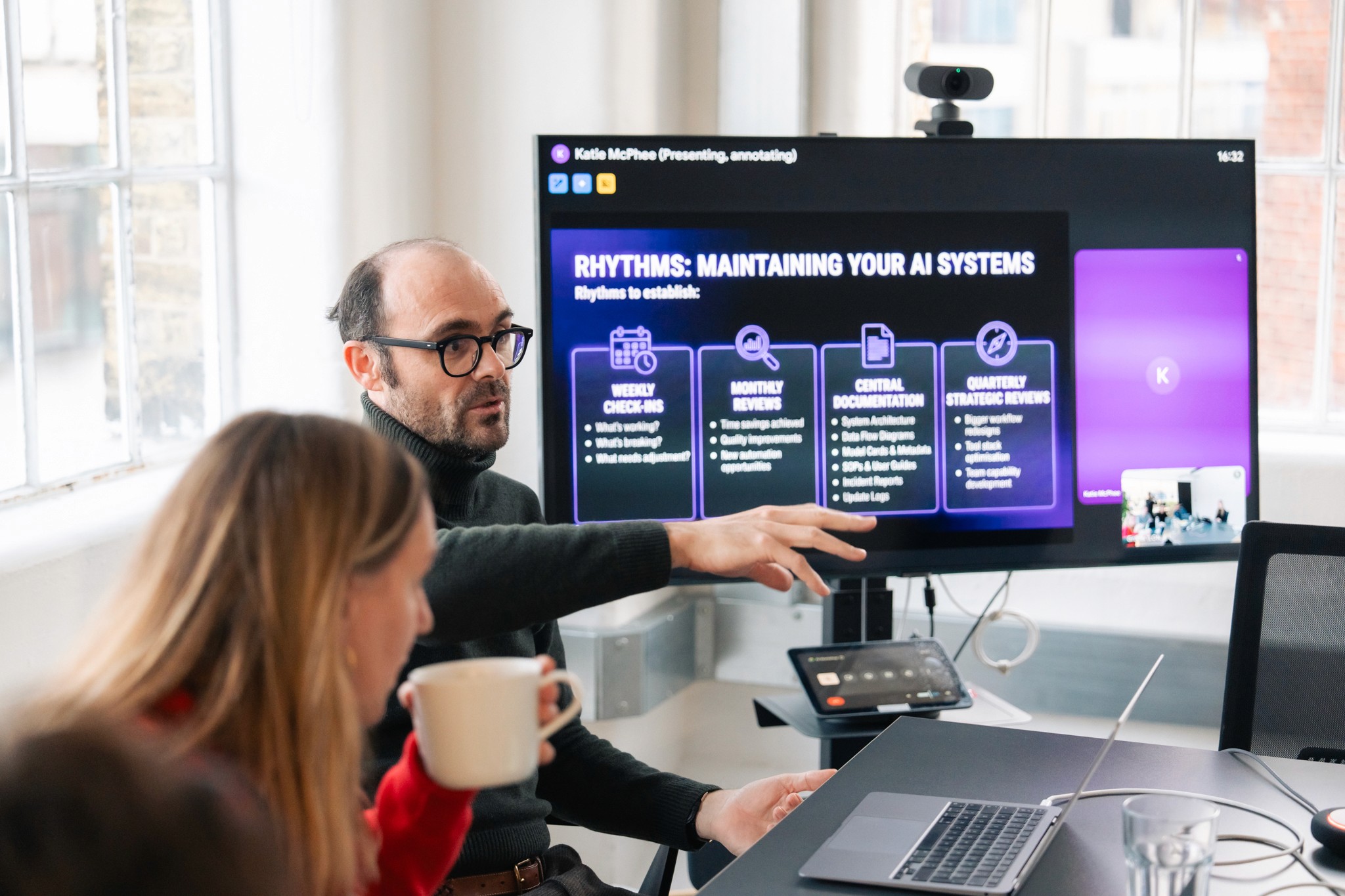
Vidal implemented a structured approach to sustaining momentum. Weekly check-ins maintain visibility, dedicated learning time legitimises ongoing skill development, and a peer learning model enables knowledge transfer across the team.
"We run Monday morning check-ins where the team shares progress, troubleshoots challenges and demonstrates new capabilities they have developed," Vidal explains. "That regular cadence keeps AI deployment visible and creates accountability. We also allocate two hours per week for dedicated learning, which signals that this is strategic work, not discretionary activity that gets deprioritised when we are busy."
The team has adopted a super-user model, where individuals with particular aptitude in specific areas lead capability development and support colleagues. Documentation in Confluence captures effective practices, prompt libraries and solution templates.
"The structure ensures this becomes embedded practice rather than a one-off initiative," says Vidal. "The results create their own momentum. When someone produces a visual asset in 20 minutes instead of 90, or builds an email sequence in 15 minutes instead of two hours, those tangible wins drive continued engagement."
Broader Organisational Impact
The marketing team's progress has generated interest from other functions. Customer success, sales operations and product teams have requested guidance on applying similar approaches to their workflows.
"We are becoming internal champions for effective AI deployment," Vidal notes. "Other teams can see the results we are achieving and want to understand how to replicate that in their domains. That was not an explicit goal, but it may prove one of the most valuable outcomes: creating organic adoption through demonstration rather than top-down mandate."
Even senior leadership has begun experimenting with AI tools based on the marketing team's visible success, though with varying degrees of sophistication. "Our CEO started using Gemini for press releases," Vidal observes. "Though I can immediately identify when content has been AI-generated based on certain linguistic patterns. But the point is, people across the organisation are paying attention to what we are achieving."
Future Development
The team has identified several areas for continued capability building, including advanced integration with HubSpot for lead scoring and email personalisation, Notebook LM deployment for knowledge management and thought leadership content development, and Braze automation for sophisticated investor nurture sequences.
"The original workflow audit contained dozens of opportunities," Vidal reflects. "We tackled the highest-impact workflows in the initial workshop, but there is substantial additional value to capture. The team now has the framework to continue building solutions independently. That self-sufficiency was the ultimate objective."
Business Outcomes
Operational efficiency: 25-50% time reduction on core marketing workflows
Quality improvement: Enhanced consistency and compliance driving stronger engagement
Capability transformation: Team proficiency increased 75% within four weeks
Strategic capacity: Senior resources redeployed from execution to strategy
Organisational influence: Marketing becoming centre of excellence for AI adoption
Sustainable practice: Weekly cadence and peer learning embedding new capabilities
"The investment delivered exactly what we needed," Vidal concludes. "Not generic AI literacy, but practical capability development that translated directly into operational improvements. For a lean team competing in a fast-moving market, that efficiency and quality advantage is strategic."
About The AI Playbook Sprint Workshop
The AI Playbook Sprint Workshop addresses a fundamental challenge in AI adoption: translating tool access into operational capability. Through bespoke workflow mapping, structured methodology and hands-on solution building, teams develop practical expertise that delivers measurable efficiency gains from day one. The approach is grounded in the COM-B framework for behaviour change, ensuring capability development is sustainable rather than dependent on ongoing external support.

Solution - Communication and Deployment
Effective communication and smooth deployment are at the heart of our process. We keep you informed every step of the way, ensuring your vision is brought to life exactly as you imagined. Our team collaborates closely with you to address any questions or concerns.
Communication
Clear communication and efficient deployment are essential to the success of any project. We maintain open lines of communication throughout the entire process, ensuring your goals and expectations are met. Our team actively listens and collaborates with you to refine details and offer guidance. When it’s time to deploy, we ensure a smooth transition, handling all technical aspects to guarantee a flawless launch.
More Other cases



Human-first AI adoption
Frequently
Asked Questions

Find out how AI-ready your team really is
Take our 5 minute assessment and get a personalized readiness score plus specific recommendations for your next steps.